

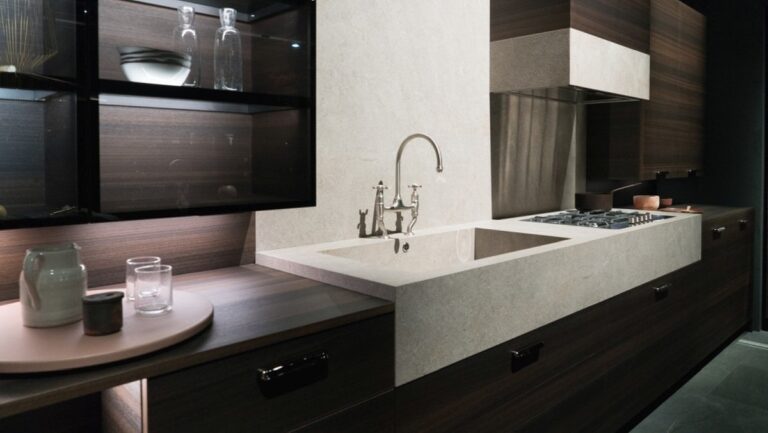

Kitchen design isn’t just evolving in 2026, it’s tightening. After walking through these spaces, what stands out isn’t a single bold feature, but how everything starts to feel more integrated, more controlled, and more intentional.
What used to be separate elements, sink, island, backsplash, appliances, are now being treated as one continuous system. And once you notice it, older kitchens start to feel fragmented.
Here are the shifts that keep showing up again and again.
1. The Sink Becomes a Full Workstation

This is no longer just a sink. It’s prep space, drainage, cutting surface, and storage built into one zone.
Instead of spreading tasks across the counter, everything happens inside the sink footprint. Sliding boards, integrated trays, and layered rails turn it into a compact workflow.
It solves a real problem. Counters stay cleaner, movement is tighter, and the kitchen feels more controlled. Once you use one, a basic sink feels incomplete.
2. Islands Are Becoming Split-Level Work Zones

Flat islands are starting to feel too simple.
More kitchens are breaking the island into layers. One level for prep, another for eating, sometimes even a third for display or storage.
It creates subtle separation without adding walls. Cooking stays functional, while the dining side feels calmer and more intentional. It’s a small shift, but it changes how the space is used.
3. Hidden Ventilation Is Replacing Overhead Hoods

Instead of bulky hoods, ventilation is moving into the countertop. Pop-up systems and integrated downdraft vents disappear when not in use.
This shift is less about tech and more about visual calm. Without a hood breaking the line of sight, the kitchen feels more architectural and less like a workspace.
4. Cabinets Are Turning Into Display Walls

Tall cabinetry is being broken with glass sections, lit interiors, and open niches. The result sits somewhere between storage and display.
It adds depth to flat walls and gives kitchens a more furnished feel. Instead of a solid block of cabinets, you get rhythm and variation.
5. Appliances Are Fully Integrated Into the Architecture

The trend isn’t just panel-ready appliances. It’s complete disappearance.
Ovens, fridges, even coffee machines are aligning perfectly with cabinetry lines. No gaps, no breaks, no visual interruptions.
The kitchen stops looking like a collection of products and starts reading like a single built structure.
6. Dark Stone Is Replacing Light Countertops

White quartz isn’t disappearing, but it’s losing dominance.
Darker stones with visible veining are taking over islands and backsplashes. Black, deep brown, and charcoal surfaces create contrast and weight.
They anchor the kitchen visually. Instead of everything blending together, the space gains a strong focal point.
7. Stainless Steel Is Coming Back (But Cleaner)

Stainless steel isn’t just for commercial kitchens anymore.
It’s returning in a more refined way, thin sheets, seamless installations, and paired with warmer materials like wood or stone.
The effect is sharper and more technical, but still controlled. It adds a precision that softer materials alone can’t achieve.
8. The Sink Is Becoming a Sculptural Element

Beyond function, sinks are becoming part of the design language.
Large, integrated basins carved from the same material as the countertop create a seamless, almost sculptural effect.
There’s no visual break, no edge, no transition. Just one continuous surface that feels intentional and heavy.
What Actually Defines 2026 Kitchens
It’s not about adding more features. It’s about reducing friction between them.
The kitchens that stand out right now feel tighter, calmer, and more resolved because everything connects. Surfaces continue, appliances align, and nothing feels like it was added later.
A few shifts keep showing up:
- Surfaces are starting to run continuously – Countertops extend into backsplashes and sometimes into the sink, removing visible breaks and making the whole wall read as one element.
- Upper cabinets are being simplified or reduced – Instead of full runs, storage moves into tall blocks or becomes more selective, often mixed with display sections.
- Lighting is built into the structure – Thin integrated lines replace most visible fixtures, quietly defining edges, shelves, and work zones.
- Everything sits on the same plane – Appliances, panels, and handles align flush, so nothing interrupts the cabinetry.
- Layouts are tightening into compact work zones – Instead of spreading functions across the room, cooking, prep, and cleaning are grouped more efficiently.
Put together, these changes explain the shift. The kitchen stops feeling assembled piece by piece and starts reading as a single, controlled space.