


Want a kitchen to feel open and warmer without turning it into a plain white box? This remodel shared by Reddit user Pretty-Carpet3227 shows how changing the structure, materials, and sightlines can shift the feeling of an older brown kitchen.

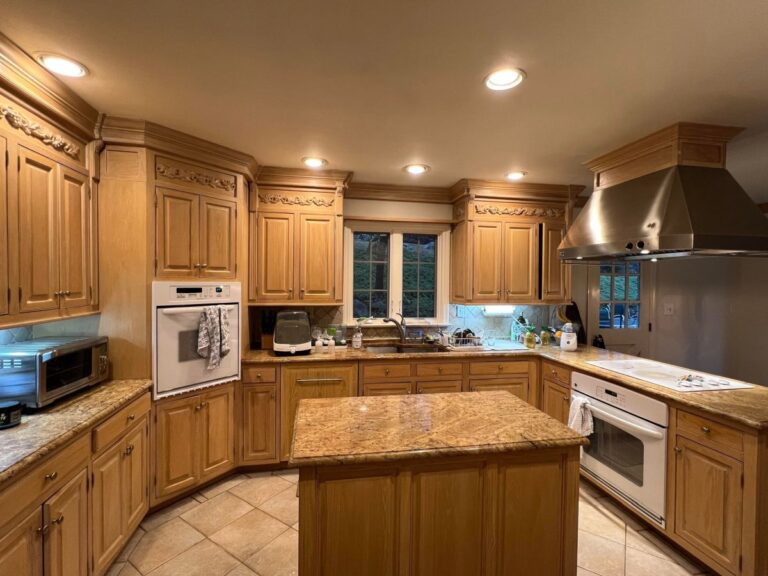
The original kitchen had many of the features common in late ’90s layouts. Medium-tone wood cabinets wrapped around the room, upper cabinets covered most walls, beige tile floors cut the space into sections, and a large stainless hood dominated the center wall. Even with windows around the room, the kitchen still felt enclosed because dark cabinetry controlled most of the visual space.

After the renovation, the kitchen connects to the dining and seating areas through one continuous layout. Shaker cabinets, stone walls, a plaster hood, brass hardware, wood beams, and an alcove seating bench replace much of the decorative trim and heavy cabinetry that defined the original space.
Walls Were Removed to Open the Kitchen Into One Space
Before the remodel, the kitchen, laundry, and mudroom areas felt separated by partitions and cabinet walls. Circulation paths narrowed around the island and corners, which made the layout feel tighter than it was.
During demolition, many of those divisions came down. Once the walls opened up, the kitchen started functioning as part of the larger living space instead of sitting inside its own enclosed zone.
The island became the center of the room rather than another obstacle between walkways. Its larger scale now connects the prep area, seating, and surrounding rooms into one layout.

The Alcove Window Seating Bench Changed the Back of the Kitchen
One of the biggest changes appears at the breakfast nook.
Instead of leaving the alcove as a separate dining corner, the remodel built a seating bench into the window area. This turns the end of the kitchen into usable architectural space instead of transitional space between walls.
The larger windows also become more visible because dark upper cabinets no longer surround them. Natural light now reaches deeper into the kitchen and reflects across the lighter finishes.
The woven pendant above the table and exposed wood beam help define the alcove without separating it from the rest of the room.

Shaker Cabinets and Stone Walls Replaced Heavy Trim
The original kitchen depended on raised-panel cabinets, decorative molding, and layered trim details to fill the walls.
In the remodel, simple shaker cabinets replace the ornate cabinet fronts, which gives the kitchen flatter and cleaner surfaces across the room. Sections of upper cabinetry were also removed and replaced with textured stone walls around the breakfast nook and sink area.
This keeps texture in the room without bringing back the heavy appearance of the old kitchen. Instead of every wall functioning as storage, some surfaces now work as architectural features.
Brass hardware repeats across the cabinetry and ties into the faucet, sconces, and pot filler, helping the different materials feel connected.


The Stove Wall Became the Main Feature
The original stainless hood sat heavy in the middle of the kitchen with hard edges and dark surfaces.
The new plaster range hood changes the appearance of the entire cooking wall. Curved supports soften the structure, while the exposed wood beam ties into the flooring and surrounding wood details.

The brass pot filler also turns the stove wall into a focal point instead of leaving it as a standard appliance zone between cabinets.

The Farmhouse Sink and Brass Faucet Changed the Sink Wall
The old sink area blended into the darker counters and surrounding cabinetry.
Now the farmhouse sink projects forward from the cabinet line, which gives the sink wall more depth. The brass faucet stands out against the white counters and stone backdrop without extra decoration around it.

Removing many of the upper cabinets reduces enclosed storage compared to the original layout, and the stone walls replace surfaces that once held cabinetry. Compared to the original brown kitchen, the remodel opens the sightlines, centers attention around the alcove seating bench, and replaces decorative trim with architectural features that shape the room itself.