

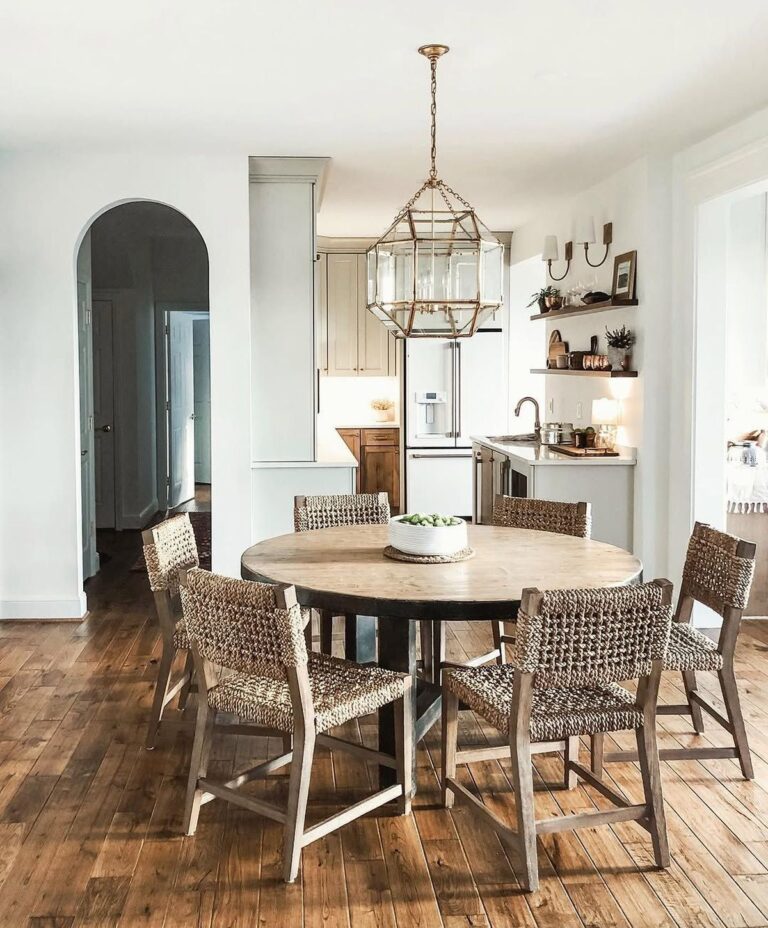

Small kitchens rarely have space for a separate dining room, yet they almost always have gaps that never get used well. In 2026, those gaps are no longer left empty. They are turned into compact dining zones that sit directly inside the kitchen layout.

Round tables make this possible. Without corners, they open movement paths, fit between islands and walls, and allow chairs to tuck in without blocking access to cabinets or doors. Instead of forcing a dining setup, they adapt to the space that already exists.
These kitchens show how placement changes everything. Some tables sit tight against a cabinet wall, others float near windows or align with the island edge. Each one turns leftover space into a defined place to sit, without breaking the way the kitchen works.
Curved Banquette Wrapped Into the Island Edge

The table is built into a curved bench that follows the island corner. This removes one full side of chairs and keeps the outer edge open for movement between kitchen zones and the doorway. The table base sits tight to the island panel, so the dining spot feels attached, not placed.
The bench height lines up with the island counter, which keeps both elements in the same horizontal band. The colored glass pendants hang over the island, not the table, so the dining area stays quieter while still sitting inside the main kitchen zone.
Round Table Positioned Inside the Entry Light Zone

The table sits directly next to the glass door and window wall, using the brightest part of the room. The rug marks the dining footprint, keeping the table from drifting into the open floor. The position leaves the island fully accessible from all sides.
The distance between table and island is enough for a clean pass-through path. Chairs tuck under the round edge, which avoids blocking the door swing or the walkway toward the kitchen.
Centered Table Along the Window Wall Run

The table is placed parallel to the long wall of windows, not the island. This shifts the dining zone to the perimeter and frees the center of the kitchen for movement. The spacing allows a full path between table and island seating.
The chair frames and blue seats echo the island stools, which ties both seating areas together. The table does not interrupt cabinet access since it sits outside the main working line.
Compact Table Between Island and Side Wall

The table fits into the narrow gap between the island and the right wall. The clearance is minimal but controlled, with chairs that slide fully under the top. The pendant drops low to mark the dining zone without using floor elements.
The table aligns with the island edge, so both read as one continuous line across the room. The sink and prep area stay clear because the table sits outside that working strip.
Dark Table Anchored by a Built-In Floor Pattern

The table sits directly over a geometric floor inset that defines its exact position. This removes the need for a rug and fixes the dining area inside the open layout. The chairs stay within the border, keeping the pattern visible.
The darker table contrasts with the light cabinetry and pulls weight into the center of the room. The position keeps it away from the stove and corner workspace.
Round Table Aligned With Island Seating Row

The table is placed in front of the island, on the same axis as the bar stools. This creates two seating zones in sequence rather than competing positions. The gap between them allows circulation from both sides.
The wood island base and table top share tone, which connects both pieces into one block. The table stays outside the main prep triangle but still close to it.
Dining Table Set Opposite the Main Cooking Wall

The table is positioned across from the island, near the edge of the kitchen zone. It does not sit under the main lighting of the island but under its own fixture, which separates the functions.
The chairs are spaced evenly around the table with enough clearance behind for movement toward the windows and cabinets. The table acts as a secondary zone, not part of the core work area.
Round Table Framing the Seating Side of the Kitchen

The table is placed on the seating side of the room, facing the island and backsplash wall. It creates a soft boundary between the lounge-style chairs and the kitchen workspace.
The darker cabinetry behind forms a solid backdrop, so the table reads clearly in front of it. The spacing keeps a direct path between island and sink wall without crossing through the dining area.
Live-Edge Table Set Off the Island Line

The table sits forward from the island instead of aligning with it. This creates a clear split between prep and dining. The live-edge top introduces an irregular outline that contrasts with the straight cabinet lines behind.
The vaulted ceiling pulls the eye up, so the table stays low and grounded. The distance from the island allows stools and chairs to work without overlap.
Centered Round Table Against Full Cabinet Wall

The table is placed directly in front of a full wall of cabinets and appliances. This keeps the island out of the layout and makes the dining zone the central focus. The spacing allows all chairs to pull back without hitting cabinetry.
Open shelves break the cabinet run above, so the table does not feel boxed in. The position avoids blocking the sink and stove line.
Round Table Positioned as the Only Dining Zone

The table replaces any island seating. There are no stools or secondary dining points, so this becomes the only place to sit. It sits close to the cabinet run, leaving the rest of the floor open.
The soft cabinet color and light flooring keep the table from dominating the room. The chairs form a tight circle, which works in a narrower layout.
Table Integrated Into Compact Corner Kitchen

The table fits into a corner beside the cabinet run and door. The size is reduced to keep clearance for the door swing and movement to the outside. Chairs are light and low to avoid blocking the window.
The table sits outside the cooking line but still within reach. The layout keeps one clear path from entry to kitchen without crossing through the table.
Round Table Framed by Built-In Storage Wall

The table is placed directly in front of a wall of tall storage. This creates a defined dining zone against a solid backdrop. The spacing allows the chairs to move without hitting the cabinets behind.
The island sits parallel, leaving a corridor between the two. This keeps prep and dining separate but connected.
Yellow Cabinet Kitchen With Centered Dining Table

The table sits centered in front of the cabinet wall, not pushed to the side. This gives equal access from all directions and keeps the layout balanced. The pendant marks the exact middle of the dining zone.
The bold cabinet color holds the back wall, while the table remains neutral. The gap around the table allows movement along both sides of the kitchen.
Table Positioned Between Kitchen Run and Living Edge

The table sits between the kitchen cabinets and the living area boundary. This creates a transition zone rather than a separate dining room. The open side faces the sofa, not the kitchen.
The placement keeps the main kitchen path clear while still allowing direct access to the table. Chairs pull back toward the living side, not into the work zone.